
The Lord's Supper : Thanksgiving
PRACTICING YOUR FAITH
Mark Warner
7 min read
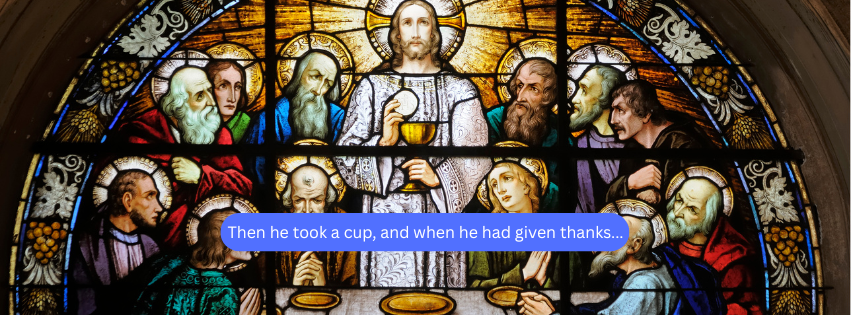
At the beginning of the Lord’s Supper, we always give thanks. Thanksgiving is fundamental to the act of coming to the table. It’s the first thing we do as we gather around the table, just as Jesus did with his disciples. This is why the historic church has referred the Lord’s Supper as the…
Eurcharist ~ Greek for “thanksgiving” or “gratefulness”
Giving thanks opens our hearts to receive from God. It opens space for the blessings of the kingdom. Thanksgiving is synonymous with celebration and the Lord’s Supper is a celebration with a history rooted in the Passover. The Apostle Paul calls this out in 1 Corinthians 11:23. He writes,
For I received from the Lord what I also passed on to you: The Lord Jesus, on the night he was betrayed, took bread.
What night was Jesus betrayed? He was betrayed on the same night he and his little band of followers celebrated the Jewish Passover. Now, in all likelihood, Jesus was probably celebrating the Passover a day early, on Thursday night. Passover lambs, according to John's gospel, were killed the next day on Friday at just the time Jesus was crucified. The lamb was central to the celebration of the Passover. It’s likely that Jesus celebrated the Passover the night before without a Passover lamb or, more accurately, it’s likely that Jesus celebrated the Jewish Passover with himself as the Passover Lamb. But the Lord’s Supper arose from Jesus' celebration of the Jewish Passover.
The Passover was the Last Supper Jesus enjoyed with his followers. And it’s the story of the Passover, the old, old story of Israel being rescued out of slavery in Egypt, the story of God’s judgment on the enemies of his people, the story of God’s protection over those who were covered by the blood of the Passover lamb, it’s that story that Jesus now retells. He uses the Passover story to help them understand the reason why he came into the world. He reenacts the familiar story for his Jewish followers, giving the story a new meaning, casting himself as the Passover Lamb who takes away the sins of the world. It’s a dramatic moment. Picture it with me for a moment.
Jesus is the host of the Passover. He’s the rabbi, the spiritual father. It’s the father's job at the Passover meal to tell his children the story of the Passover. So Jesus begins, “We were once slaves in Egypt, held captive. But God, our Father, rescued us from captivity by coming to our aid.” And, then, I can almost hear Jesus say, “We, in our day, are enslaved. We’re subject to a master far worse than Pharaoh, held in a merciless bondage crueler than the bondage of our forefathers.” The anticipation of the disciples would, no doubt, have grown as he’s telling the story over the course of the evening. Could it be? Is Jesus, our spiritual father, going to set up free? Is he going to deliver us from the hands of our enemies? Of course, in their minds, when they thought about their enemies, they thought of the Romans, about the occupation of their country, about the confiscation of their very best — their money, sometimes their homes, their sons were involuntarily forced into the Roman army, their daughters were sometimes forced to wait on wealthy Roman women as servants. “Is Jesus promising us liberation?”
And then, as the host, Jesus would have taken the unleavened bread. In the Passover meal, there would be three matzos on a plate. In a Jewish home, at the beginning of the meal, they always take the middle matzo, break it, wrap half of it in a cloth and hide it away. Then, at the end of the meal, they would retrieve the middle matzo, unwrap it and hold it up.
I have a friend who grew up celebrating the Passover in a Jewish home. At the age of 18, he met the women who would become his wife. She was a Christian. Early in their relationship, she told him the story of the Bible — how God created human beings, how our first parents, Adam and Eve, rebelled against God and how every person in every culture since has experienced the ripple effect of that rebellion, how we’re all, by nature, moving away from God, doing our own thing but God sent his Son, Jesus, into the world to restore our relationship with Him by dying for our sins. God has done everything necessary to accomplish our salvation if we’ll just receive his free gift by faith.
When my friend heard the story, it didn’t make sense to him until his future wife invited him to a Passover dinner presided over by a Jewish believer in Jesus. He held up the plate with the three matzos, and he said, “Do you know what these three matzos represent?” My friend thought that he never really understood the significance of the three matzos. His rabbi used to say that they may represent the three patriarchs of Israel — Abraham, Isaac and Jacob — or the priests, the Levites and the people of God, but no one knew for sure. Then their host said, “These three matzos represent the three persons of the Trinity — the Father, the Son, and the Holy Spirit. And remember, we always take the middle matzo and break it. We wrap half of it in a cloth and we put it away. And then, we take it out again at the end of the meal, unwrap it and hold it up. Do you know what that means?” My friend didn’t have a clue. If you read the rabbis, he thought, there are all kinds of possible interpretations, but there’s no certain meaning. How it originated in history is completely lost to us. The man at the front said, “Here’s the meaning. The apostle Paul wrote,
The Lord Jesus, on the night he was betrayed, took bread (1 Corinthians 11:23).
He, then, took the middle matzo, the one representing the Son of God, he broke it and read the next verse where Jesus said,
“This is my body, which is for you; do this in remembrance of me (v. 24).”
“And remember,” the man said, “this broken body of Jesus was then wrapped in a cloth, in a funeral shroud, and placed in a tomb. He was hidden away. And then, three days later, the stone in front of the tomb was rolled away and when the disciples went to look for him, he wasn't there. All they found were the strips of cloth because he had risen from the dead.” When my friend heard these words, when the host took the middle matzo, broke it and said, “This is my body, which is for you, do this in remembrance of me,” my friend felt like the Spirit of God hit him in the chest. He had one of those horribly unsettling moments where he suddenly realized, “Oh, my goodness, all of this is true! It’s all true! I’ve turned away from God. I’ve gone my own way. And God, out of love, sent his Son to rescue me by his broken body and his shed blood.”
It’s all for you
One of the most important words in this whole text is the preposition “for” in verse 24. It says,
And when he had given thanks, he broke it and said, “This is my body, which is for you.”
There’s a world of meaning packed into that little, three-letter word. As we meditate on it, we’re plunging into the very heart of the Christian message. Christ for you and for me! Theologians will talk about the doctrine of substitution. Do you know what a substitute is? In school, growing up, it’s an excuse not to pay attention, but a better illustration comes from the world of sports. In baseball, when a manager makes a substitution, he puts one player in the place of another. One person bats instead of another. The word “for”, in verse 24, is referring to a similar substitution. Christ died for you. He went to bat for you. He faced God’s judgment for you. Christ for you. Do you ever think about that, Christ for you, instead of you, in place of you? Do you ever think about the extraordinary exchange that took place on the cross? All that’s wrong with you —your sin, your unbelief, your moving away from God — all that is placed on Christ and everything that belongs to Christ — his right standing with God, his holiness, his goodness, his purity, is placed in your account. He, as our substitute, takes our judgment and death and gives us his life and salvation.
In the early days of the last century, wood-burning locomotives moving along the intercontinental railway ran from town to town throughout the midwest. These old locomotives would often set fires on either side of the tracks as sparks flew from their stacks. As wheat famers know, there’s a ten-to-fifteen day period when the wheat is ripe enough to burn but not yet ripe enough to cut. In those early days, wheat fires were common and they sometimes burned for miles, sweeping across the plains, before a farmer would see the fire burning toward his buildings.
One farmer saw the smoke of one of these great fires just northwest of this farm. Judging the direction of the wind, he knew the fire raging in the distance would eventually burn his wheat right down to the barn, taking the barn, his cattle, his other livestock and his house with it. He had to do something to stop it. So, he took a torch and ran to the edge of the field to light a back fire. As his fire began to burn - 100 yards, 200 yards -- it created a burned out circle around the buildings. As the wildfire approached and met the fire break, it went around the house and barn, leaving them untouched.
The farmer had saved his buildings but he lost his crop. Later, in his grief, he walked through the burnt stubble and came upon the charred body of a hen lying there on the ground. He thought the hen must have become confused, running toward instead of away from the fire. Idly, he turned the body over with his toe of his boot and out from underneath the hen ran a dozen little chicks. The mother had covered them. She placed her body between them and the fire. She was burned but they were saved.
Christ for us. The whole Bible is a book about how to find freedom. Every one of us in on a search for freedom. We want to finally get free of the things that bind us — our past, our mistakes, the things that have been done to us, the abuse, freedom from traumatic memories. I know most everyone is longing for freedom from something. You have a life-controlling habit, are dominated by anxiety, worry and fear, maybe you’re addicted to pornography or you have an eating disorder or you can’t seem to break free of the continual cycle of going from one bad relationship to another. Do you understand what Jesus is offering through his broken body and shed blood? He’s offering to cover you. He’s offering a new exodus! He’s offering you freedom! The Lord’s Supper is a celebration of thanksgiving.
Get In Touch
