
The Lord's Supper : Submission
PRACTICING YOUR FAITH
Mark Warner
4 min read
The Lord’s Supper is an invitation to submission. The table leads us into submission to Jesus Christ as Lord. There can be no kingdom without a King, and Jesus alone is Lord and King, so we begin by subjecting ourselves to his rule and reign over us. As we move closer to the table, into the very core of Christ’s presence there, he draws us into loving submission, to laying down our wants, desires and demands in favor of realigning our hearts to his will for us, helping us embrace what our hearts should desire. This submission to Jesus, then, spreads out into mutual submission to one another, where we learn to put each other ahead of ourselves. This is what the Kingdom of God looks like among us.
In Luke 22, Jesus is inaugurating the table at the Last Supper, and the issue of mutual submission rushes to the forefront. In the middle of the meal, around the table, a dispute breaks out among the disciples. They were arguing among themselves over which one of them would be the greatest in the kingdom to come! Can you imagine it? Jesus is sitting right there. Not one of their finer moments. How does Jesus respond? He completely rejects the way the world looks at authority and power. He says,
“The kings of the Gentiles lord it over them; and those who exercise authority over them call themselves Benefactors. But you are not to be like that. Instead, the greatest among you should be like the youngest, and the one who rules like the one who serves. For who is greater, the one who is at the table or the one who serves? Is it not the one who is at the table? But I am among you as one who serves (Luke 22:25-27).”
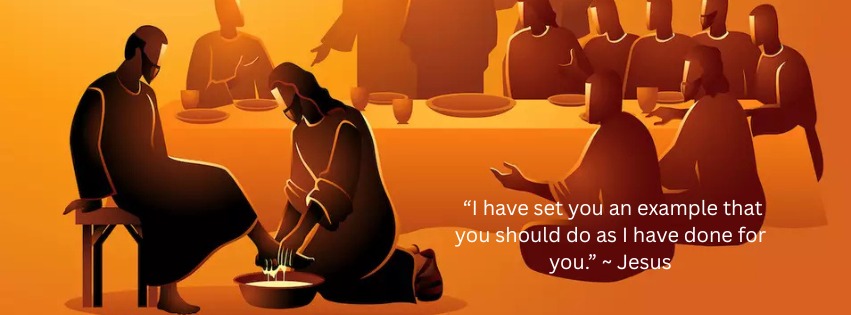
He, then, demonstrates it for them, according to John 13, by getting down on his hands and knees and washing their feet! Jesus, the King, on his hands and knees, washing dirty feet. He inaugurates the table through a demonstration of mutual submission. He could not be more explicit about the way we’re supposed to relate to one another, the way authority will be exercised in his kingdom. The whole idea was completely foreign to his disciples. It couldn’t have been more different than what they were accustomed to. The kingdom of God will be founded on mutual submission to one another under the lordship of Jesus Christ, where everyone who leads does so through submission to the rule and reign of Christ and his work among us.
In 1 Corinthians 11, the idea of mutual submission manifests itself in a different way. The whole chapter is about our life with God together. The Lord’s table is meant to help us submit to his lordship over us and to one another, putting others ahead of ourselves. But the Corinthians came to the table more concerned about themselves than anyone else. Divisions were breaking out among them. The rich were eating and indulging themselves while the poor went hungry. Certain individuals were setting themselves above others. For Paul, that meant that the Corinthians had not discerned or recognized Christ’s real presence at the table! They had forgotten, like the disciples in Luke 22, that he, himself, was right there with them! So Paul writes,
Whoever eats the bread or drinks the cup of the Lord in an unworthy manner will be guilty of sinning against the body and blood of the Lord. Everyone ought to examine themselves before they eat of the bread and drink from the cup. For those who eat and drink without discerning [or recognizing] the body of Christ eat and drink judgment on themselves (1 Corinthians 11:27-29).
What the apostle Paul is not saying is, “I want you guys to engage in morbid introspection. So poke around your memory, probe for every possible sin you have ever committed and stay away from the Lord’s Table until you’re absolutely sure you’ve confessed it all.” If that’s what he’s saying here then I would ask, “Who would ever take communion?” The self-examination that the apostle Paul is calling for is not just of your individual sins. He’s talking, in this context, about your attitudes towards other people in the church and the larger community of God's people.
When you take communion you ought to be asking yourself several questions. You ought to say, “Is there anyone that I'm at odds with in the church? Is there anyone that I'm not committed to forgive? Is there anyone towards whom I don't have a reconciling heart?” Paul is saying, “Do you recognize Christ in your brother or sister?” When you take this bread, you’re betraying the very presence of Christ in your midst if you reject Christ in your brother or sister. If you’re comfortable with racial divisions in the church, economic divisions, if you’re comfortable with bitterness and unforgiveness, if you’re not a person whose committed to heal divisions and reconciliation, then you’re taking the Lord’s Supper in an unworthy manner. It’s meant to bring us together.
Think of how earth shattering this experience of Christ at the table must have been for the early Christians. The very presence of the risen Lord is present at the table. That’s not to be taken lightly. It’s not just something we do because we’re supposed to do it or we’ve always done it. On the contrary, when we sit around the table, we sit with Jesus! We’re together in the presence of the King. And as each one of us submits to him, he enables us to submit to one another, to see each other as he sees us and to make peace. It’s in this space, at the table, that we submit all of our divisions and personal agendas to Christ’s presence. All of these things must die. And when they do, there we sit, tending to his presence and one another, an amazing, new social dynamic breaks out among us, subverting all other allegiances. Just as the table shared by early Christians turned Rome upside down, starting a new way of life before a watching world, so the Lord’s table, can upend the politics of American self-preservation, accumulation, self-indulgence and individualism and usher in a new, other’s-focused way of life before a narcissistic world.
Do you see why this matters, why it’s essential that we come to a place of submission to Christ at the table? Because God will not impose himself on us or overwhelm us. Our submission to his reign opens up space for him to work.
Get In Touch
